
Fable.
It launched, then vanished in 3 days. Here’s the 1 lesson.

Last week I almost wrote you an article telling you to go use Claude Fable 5 while it was free.
It was the most powerful model Anthropic had ever released to the public.
Launched on a Tuesday.
Free on the paid plans for a couple weeks.
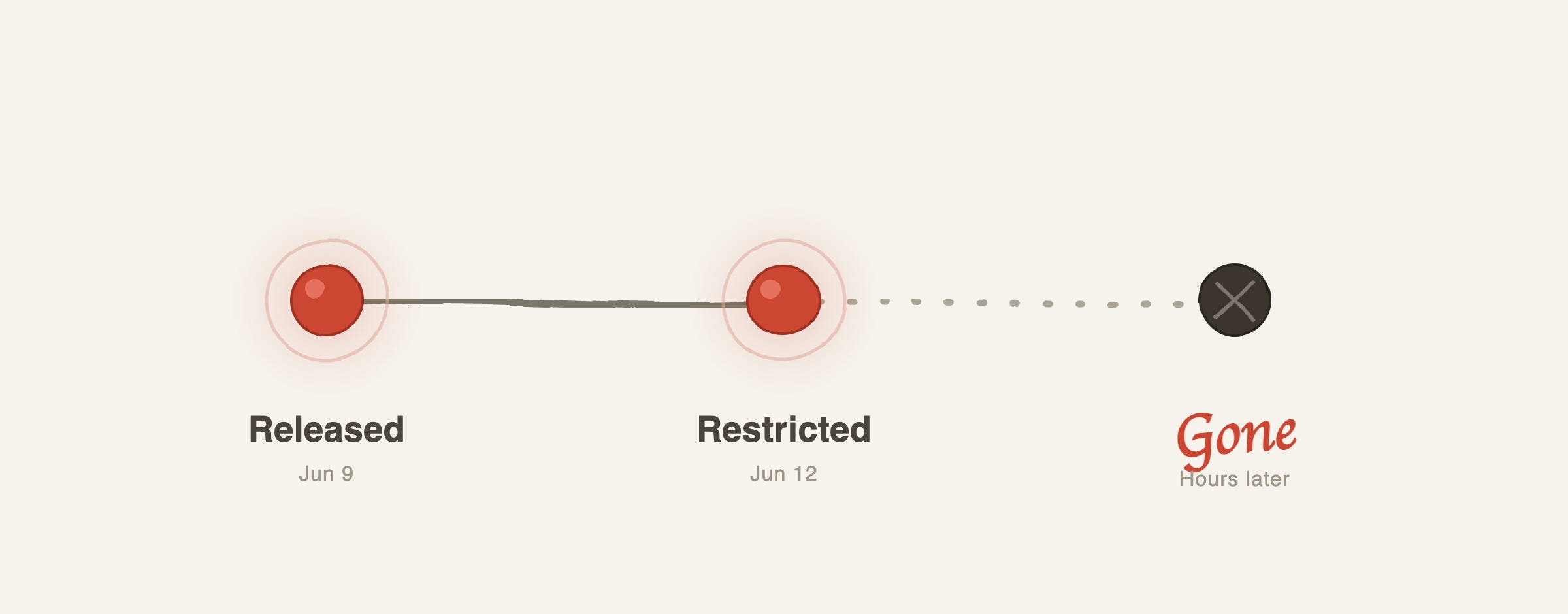
By Friday it was gone.
Not slowed down.
Not quietly retired.
Switched off… for every single user on earth… three days after it launched.
I’m glad I didn’t hit publish.
But the real story here is better than the one I was going to write.
Because what happened to Fable 5 is the clearest lesson I’ve seen all year for anyone building a product without code.
And almost nobody is talking about that part.
1. What actually happened.
The plain-language version:
Anthropic released Fable 5 on June 9.
Their best, most capable model… the kind they’d kept locked away because it was too powerful to hand out freely.
Three days later, the U.S. government stepped in.
The Commerce Department issued an export-control order, citing national security.
The order blocked the model from being used by any foreign national, anywhere in the world, inside the U.S. or out.
Here’s the catch.
Anthropic had no way to check, in real time, who counted as a “foreign national” on every request.
So the only way to actually obey the order was to shut the model off for everyone.
Which they did, within hours.
The reported trigger?
Another company claimed it had broken through the model’s safety limits.
That spooked the government.
The order followed.
Anthropic says it disagrees with the decision.
It doesn’t matter.
The model is still gone.
And the detail that should stop you cold: every other Claude model still works.
Opus, the others, all fine.
Only the two most powerful ones vanished.
Read that twice.
The more powerful the tool, the faster it disappeared.
2. Why this should matter to you (and it’s not the reason you think).
You weren’t going to use Fable 5 for most of what you build.
I told you that last time and it’s still true.
Most of what a non-technical founder builds runs perfectly on free or cheap models.
So why does this matter?
Because of what it proves.
It proves that the model your product depends on can disappear overnight.
Not because it broke.
Not because the company chose to retire it.
Because of something completely outside anyone’s control, a government order, a legal fight, a policy that changes on a Friday.
Now imagine you’d built your app around Fable 5 over the weekend it launched.
Hardcoded it in.
Told your users it was the brain behind your product.
By Monday, your product is broken.
And not because of anything you did.
This is the quiet risk almost nobody warns founders about.
When you build with AI, the smartest part of your product is something you’re renting from someone else.
And renters can lose access without warning.
That’s the lesson.
Not “Fable 5 was cool.” It’s “never let one model be your single point of failure.”
3. The one habit that protects you.
The fix is simpler than it sounds.
You don’t need to be technical to do it.
You just need to build with one rule in mind:
Stay swappable.
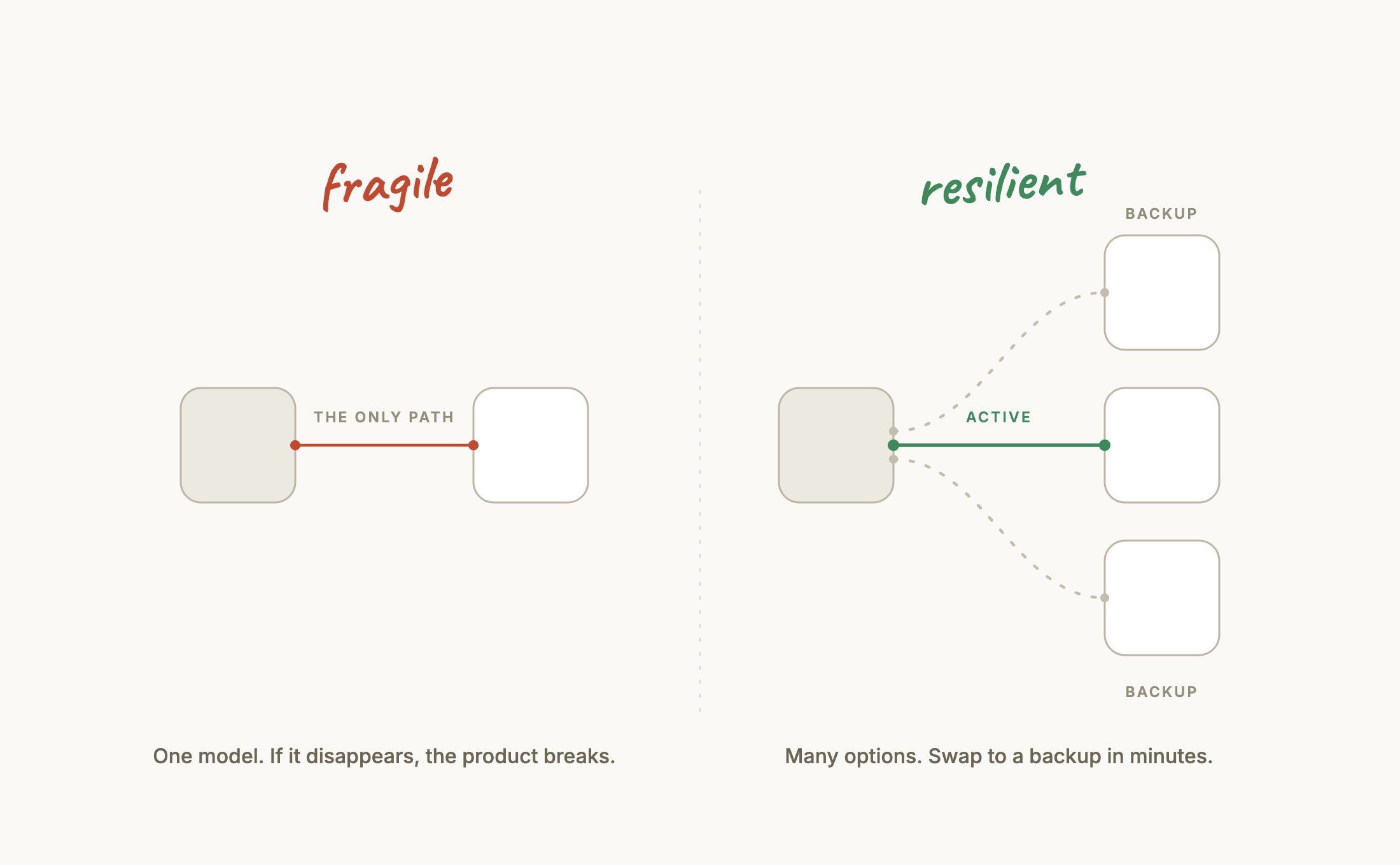
Build so that if your model disappears tomorrow, you can switch to another one in minutes, not rebuild your whole product.
Here’s what that looks like in practice, for someone who doesn’t write code:
One: never marry your prompts to one model.
Write your prompts so they’d work with any capable model.
Don’t lean on quirks that only one model has.
If your whole product only works because of one specific model’s one specific trick, you’ve built on sand.
Two: always know your backup before you need it.
For every model you use, know the one you’d switch to if it vanished.
When Fable 5 went dark, the people who were calm already knew their answer: fall back to Opus, or to Gemini’s free tier in Google AI Studio, and keep moving.
The ones who panicked had never thought about it.
Three: keep your free option warm.
Gemini’s free tier didn’t get pulled.
Free, widely available models are the most resilient thing you can build on, precisely because there’s nothing dramatic to take away.
I keep one in every project as the floor I can always drop to.
Here’s a prompt to pressure-test your own setup right now:
I'm a non-technical founder. I want to find the single points of
failure in the product I'm building with AI.

Here's how my product works: [describe it in plain language —
what it does, and where AI is involved]
Here's the AI model or tool I'm currently relying on: [name it]

Tell me:
1. If that one model disappeared tomorrow, what exactly in my
   product would stop working?
2. Which parts depend on something only that specific model can
   do — versus things any capable model could handle?
3. What's the simplest free or low-cost model I could fall back
   to, and what would I lose by switching?
4. The 3 changes I should make now so a single model going away
   never takes my whole product down.

Keep it in plain language. No jargon. Assume I don't write code.
Run that today.
Whatever it flags is the work worth doing this week… far more than chasing whatever model is newest.
If this is useful, send it to one founder who’s building everything on a single model right now.
4. The part everyone’s getting wrong.
There’s a loud reaction to all this.
“See? AI isn’t safe to build on. Wait until it settles down.”
That’s the wrong lesson, and it’ll cost you.
AI isn’t going to “settle down.”
Models will keep launching, changing, and occasionally disappearing.
That’s the weather now.
You don’t stop building because of weather.
You build for it.
The founders who win in this environment aren’t the ones who pick the perfect model.
They’re the ones who build so that no single model can hurt them.
Swappable prompts.
A known backup.
A free floor underneath everything.
That’s a full system, how to structure a product so it survives any one tool vanishing, how to keep your prompts portable, how to wire in a fallback without touching code.
The single-point-of-failure prompt above is the first piece of it.
The complete version, mapped onto a real product, is what we work through in the community every week.
Two ways to take this further, depending on what you need.
If you want to build this yourself: alongside other non-technical founders thinking through the same risks, the community is where we do this every week.
→ Join Prompts2Products: ($29.99/month)
If you’d rather hand it off, my agency Arehsoft builds products for founders the resilient way from the start, so a model going dark is never your problem.
→ Schedule a free consultation call
Both paths work.
Just different timelines and different involvement.
I don’t share things I haven’t tested.
This next prompt is my “model exit plan”, the one I now run on every project so I’m never caught flat.
It just got added to the vault.
Help me build a model exit plan for my product, so I'm never
stranded if an AI model disappears.

My product: [describe it]
The AI model I currently rely on: [name it]
My budget reality: [free only / a little / flexible]

Give me a simple one-page plan with:
1. PRIMARY — the model I use day to day, and why.
2. BACKUP — the next model I'd switch to immediately if the
   primary vanished, ranked by how close a replacement it is.
3. FREE FLOOR — the free model I can always fall back to, even
   if it's slower, so my product never fully stops.
4. SWITCH STEPS — the exact, plain-language steps to swap models,
   written so I could do it in under an hour under pressure.

No jargon. Assume I don't write code. Make it something I can
print and tape to the wall.
I’m not here to scare you off building with AI. The opposite.
I share what I actually build with, what I actually test, and what actually keeps founders safe when the ground moves, and last week, the ground moved.
People read this because someone they trusted sent them an article.
If this one was useful, be that person for someone else.
If someone sent you this, you can subscribe here: